How we work
We study the operation first. Then we decide what deserves building.
A dependable way of working, adapted to each operation and never forced through an identical template. Most of it happens before any code is written — because the expensive mistakes all get made in that window.
The engagement
Six phases, in this order, every time.
The phases are constant; how long each one takes and how much of it is needed changes completely from one operation to the next.
Phase 1: Assess
Understand the operation, the people, the systems, the bottlenecks and the goals.
- We start with how the business actually runs today, not with a product.
- Who does what, which tools they open, and where the same information gets typed twice.
- What the owner cannot currently see, and what they have to assemble by hand to see it.
Output A shared, plain-language picture of the operation as it is.
Phase 2: Map
Document the real workflow, the data, the responsibilities and the integration points.
- Every handoff written down — including the ones that only exist in someone's head.
- Where a record is created, where it changes, and every place it has to be consistent.
- Which existing systems hold authoritative data and must be connected rather than replaced.
Output A workflow and data map both sides recognise as accurate.
Phase 3: Design
Define the architecture and the order in which things should actually happen.
- What gets kept, what gets connected, what gets sharpened, and what genuinely has to be built.
- The sequence: the change that removes the most friction first, not the biggest change first.
- Access, approvals and traceability decided up front, as part of the design.
Output An architecture and a prioritised implementation order.
Phase 4: Build & Connect
Develop, configure or integrate the capabilities the operation needs.
- Existing tools are integrated first wherever a good one already exists.
- New capability is built only where nothing suitable covers the need.
- Everything lands on the shared data layer, so information is entered once and stays consistent.
Output Working software connected to the systems around it.
Phase 5: Pilot & Improve
Test in the real operation, then train, measure and refine.
- A pilot runs against real daily use, not a demo environment.
- The people who will use it every day are the ones who test it.
- What comes back from that pilot changes the system before it goes wider.
Output A system proven in the operation it was built for.
Phase 6: Support & Expand
Maintain the system and extend it as the company grows.
- Changes are tested and rolled out in a controlled, monitored way.
- A second or third solution area is connected when it earns its place, not on a schedule.
- The system expands with the operation instead of being rebuilt from zero.
Output A system that keeps pace with the business.
The decision
Building something new is the last option, not the first.
Every capability in your operation gets one of these five answers. Four of them mean we build nothing at all — and that is the outcome we look for first.
Keep
A tool already works. It stays exactly as it is.
Integrate
It works, but sits apart. We connect it to the rest.
Improve
It's close, but slows people down. We refine it.
Replace one part
Only one piece is genuinely broken. We replace just that.
Build new
Nothing suitable exists for the need. We build it.
Which answer applies where is the main thing a Systems Assessment exists to establish. See Technology & Integrations for how a kept system gets connected rather than replaced.
The process, applied
This is what comes out the other end.
These are systems Elion designed and built through exactly the sequence above. Each capture carries its own status and disclosure — what you are looking at is stated on the image, not implied.
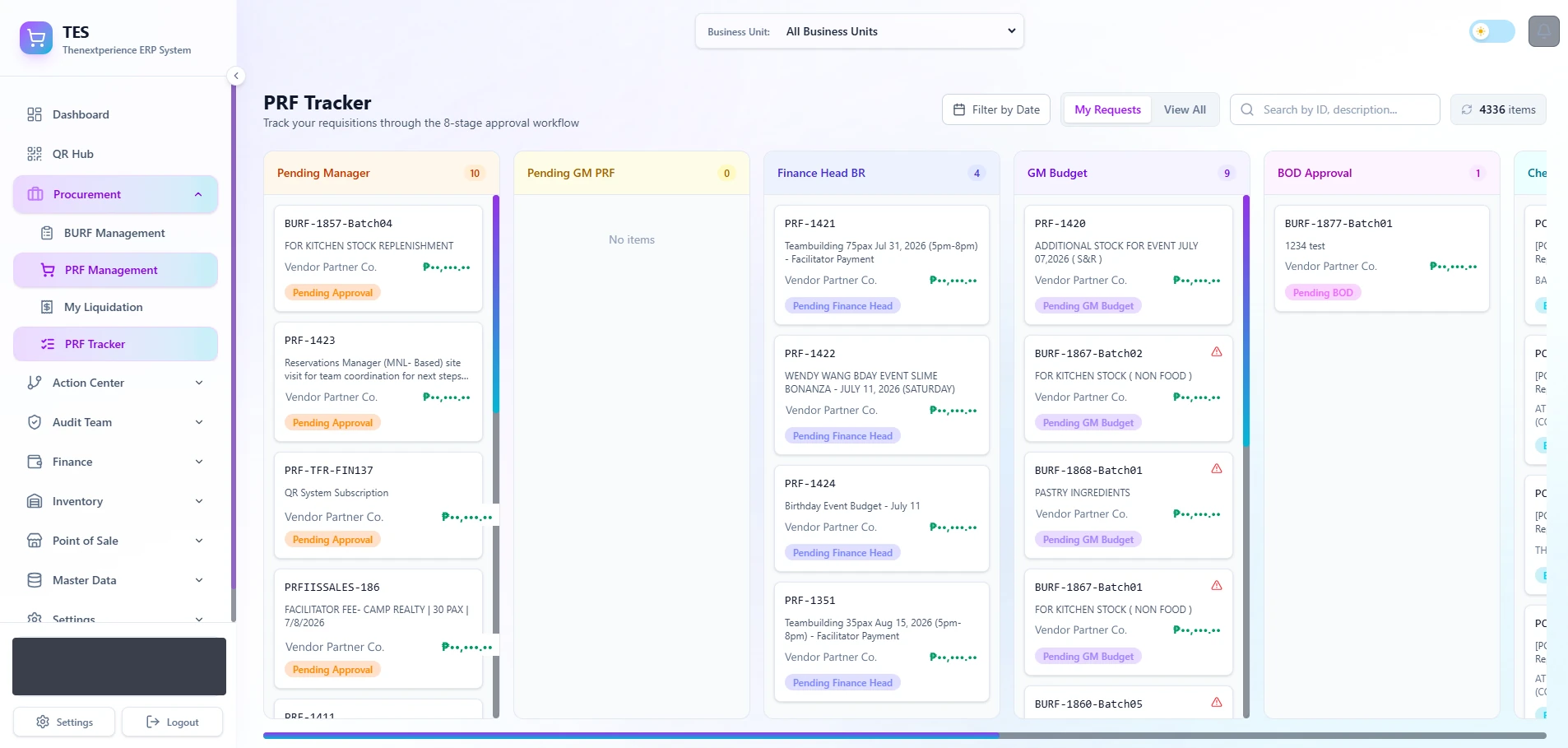
Every purchase requisition on one board, in whichever of the eight approval stages it has actually reached.
Real production data. Account-holder chip redacted before publication.
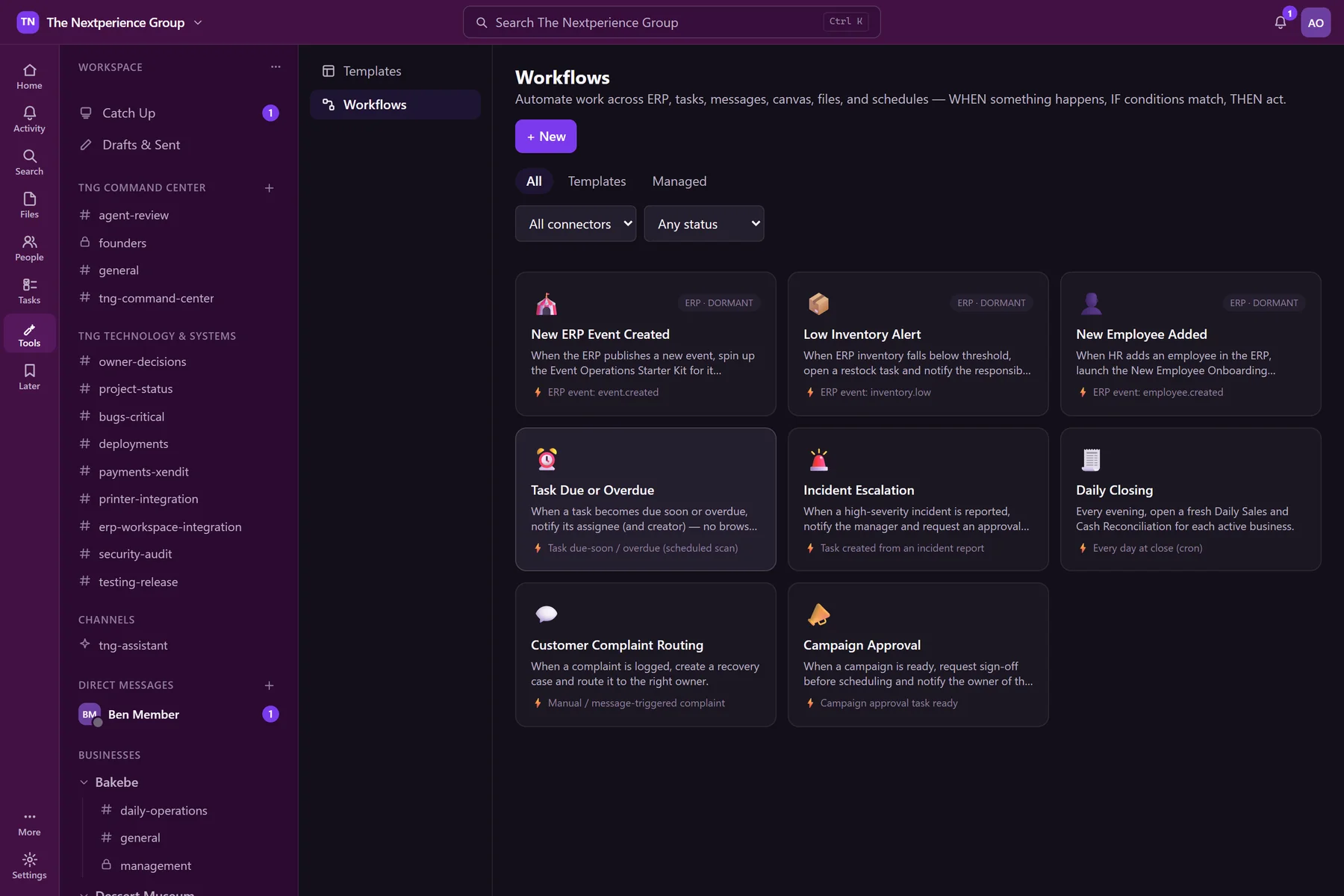
Rules that connect the ERP to the people who act on it: when something happens, if conditions match, then act.
Local demonstration with seeded accounts. Every automation shown is labelled DORMANT in the product — these rules are defined, not running in production.
How we hold ourselves to it
The commitments underneath the process.
What we do
- Software is designed around the operation, not the other way round — process changes only where the process is the problem.
- The people doing the work are consulted before the system that changes their day is designed.
- Sensitive actions keep a person in the approval loop, by design rather than as a setting.
- What a system is — production, deployment, development, demonstration or prototype — is stated plainly, including on this website.
What we don’t do
- We don't propose replacing a system that works simply because we did not build it.
- We don't quote a price or a timeline before the operation has been assessed.
- We don't start with a platform and then look for problems it happens to solve.
- We don't present demonstration data, simulated readings or a prototype as evidence of a running deployment.
The next step
Start with a Systems Assessment.
A focused conversation about how your operation runs today, where it loses time, and what a connected system would change. No obligation to build anything.
In an assessment we
- Understand how your operation runs today
- Identify the disconnected systems and bottlenecks
- Map the highest-value improvements
- Decide together whether Elion is the right fit