Agriculture & Production
Expanding capabilityConnected records, without replacing expertise.
Production cycles, field or facility activity, resources, and demand are hard to hold in one place — especially on a timeline biology sets, not software. This is Elion's expanding capability, built around human decisions, not around replacing them.
What this page is, and isn’t
- This is an expanding capability, not a completed specialty — Elion has not yet finished an agriculture or production deployment.
- Sensors and monitoring support a qualified operator's decisions. They do not replace agricultural or production expertise.
- No specific sensor, hardware, or environmental monitoring compatibility is claimed until it's verified for a real site.
- Alerts and exceptions route to a responsible person for review — nothing here acts on its own.
What this could change
One connected record, from plan to harvest.
A daily activity log, a monitoring reading, and a purchasing requirement usually live in different places, if they're recorded at all. Connected, they become one history a producer can actually compare against the plan.
Recognizable pressures
Where records and visibility usually break down.
- Production-cycle stages tracked on paper, if tracked formally at all
- Feed, materials, and input use recorded inconsistently across shifts
- Mortality, loss, or quality exceptions noticed later than they occur
- Purchasing decisions made without a clear view of current inventory
- Traceability that depends on someone reconstructing records after the fact
- Owners dependent on asking staff for updates instead of seeing them directly
A system being built for this
Five ponds, monitored side by side.
An aquaculture command centre Elion is building: dissolved oxygen, water temperature, pH, water level, aeration and mains power for every pond at once, with alerts when a reading leaves its band. It is a prototype running on a simulator — every value on this screen is simulated, and the product says so on screen rather than hiding it.
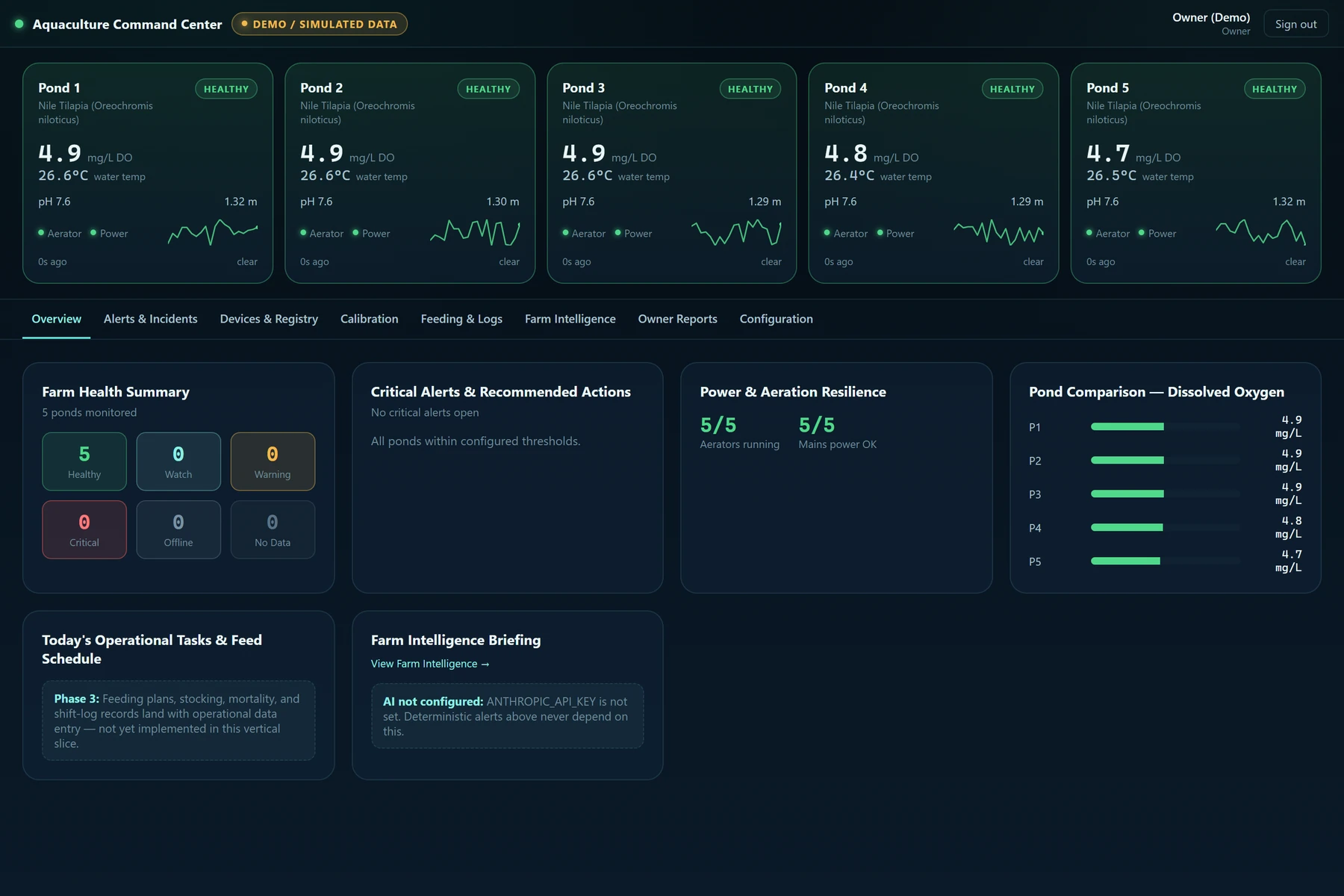
Five ponds monitored side by side — dissolved oxygen, temperature, pH, aeration and mains power, each with its own trend.
Prototype running on the simulator. Every reading shown is simulated, not measured from a real pond — the product labels this on screen.
The operational story
What one connected sequence actually looks like.
The path a single piece of work takes through the connected system, step by step — described in full rather than implied.
- 1
Plan
Stages established
A production plan sets stages, responsibilities, and expected timelines.
- 2
Record
Activity logged
Staff record real activity and material use as it happens, not from memory later.
- 3
Monitor
Observations contribute
Sensors or approved monitoring systems contribute relevant, clearly-labeled observations.
- 4
Exception
Flagged for review
An abnormal condition is presented to a responsible person — never resolved automatically.
- 5
Connect
Records stay linked
Inventory, purchasing, tasks, and production records remain connected as one history.
- 6
Visibility
Owner sees it
Management or the owner gets current visibility instead of asking around.
- 7
History
Supports future planning
Historical records support comparing planned against actual production over time.
The financial effect
Where operational savings can come from
These are potential mechanisms, not measured results — nothing here has been verified against a completed deployment yet.
Operational risk
Earlier visibility into abnormal conditions can help prevent a small issue from becoming a larger loss.
Waste avoidance
Better input and material control makes it easier to identify avoidable overuse or waste.
Labor & admin time
Fewer missing or duplicated records reduces the time spent reconstructing what actually happened.
Management decision-making
Comparing planned against actual production reduces an owner's dependence on fragmented, informal updates.
Actual financial impact depends on the company’s existing processes, transaction volume, operating conditions, implementation scope, and adoption. A Systems Assessment identifies which opportunities are real and measurable.
How the solutions could apply here
Operations and monitoring, connected — Build where a site genuinely needs it.
Holds production records, inventory, and purchasing as one connected history.
Routes tasks and flagged exceptions to whoever is responsible for that stage.
Fills gaps specific to a site's real process once a genuine need is confirmed.
Data carries information between whichever of these are in scope — not every engagement needs all five.
Where to begin
What Elion may keep, connect, improve, automate, or build.
Keep
Existing records or tools that work stay in place.
Connect
Monitoring or inventory tools sitting apart get connected.
Improve
A working but slow process gets sharper, not replaced.
Automate
A manual recording step a system could safely do gets removed.
Build
Where a site's process needs something purpose-built.
When it fits
An assessment usually makes sense when...
- Production records exist, but mostly on paper or in someone's memory
- Exceptions or losses are noticed well after they happen
- Purchasing decisions are made without a current view of inventory
- You want an honest conversation about what's actually possible today, not a sales pitch
Operating context
The most honest section on this page — there is no completed agriculture deployment to point to yet.
Agriculture & Production
Planned case studyElion has not yet completed an agriculture or production deployment. This page describes the intended architecture — a Systems Assessment would validate real sensor compatibility, production workflows, and traceability needs before any commitment.
Status reflects each system’s stage today, not a commercial claim. Verified screenshots and full case studies are in preparation and arrive in a later stage.
The next step
Start with a Systems Assessment.
A focused conversation about how your operation runs today, where it loses time, and what a connected system would change. No obligation to build anything.
In an assessment we
- Understand how your operation runs today
- Identify the disconnected systems and bottlenecks
- Map the highest-value improvements
- Decide together whether Elion is the right fit