Vision
See what’s actually happening.
Vision turns a camera or sensor environment you likely already have into operational awareness — counting, monitoring, and flagging what needs attention. It's built to support a person's judgment, not replace it.
What Vision is, and isn’t
- Vision supports human decisions — it does not replace them.
- Accuracy depends on camera angle, lighting, environment, training data, and real operating conditions.
- Sensitive decisions keep a person in the review loop, not an automated action.
- Privacy, retention, permissions, and deployment boundaries are defined per implementation, not assumed.
- This is not facial recognition, and won't be, unless a future project explicitly and lawfully requires and authorizes it.
What Vision actually is
Operational intelligence, derived responsibly.
Most sites already run cameras that record and are rarely watched back. Vision turns that same environment into counts, zone awareness, and flagged exceptions — reviewed by a person before anything happens because of it.
What it addresses
What's easy to miss without eyes on the floor.
- No visibility into what's happening on the floor without physically walking it
- Compliance or safety checks that rely on someone remembering to look
- Loss or shrinkage noticed only after a stock count, weeks later
- Queue or occupancy issues nobody sees until a customer complains
- Manual counting that's slow, inconsistent, or simply skipped under pressure
Core capabilities
What's inside Vision.
Every capability here is scoped to an approved zone and a defined purpose — not open-ended surveillance, and never a guarantee of perfect detection.
People & object counting
Counting against a defined zone and rule — not open-ended surveillance of a whole site.
Queue & occupancy awareness
Awareness of how busy a space or line is, in time to actually respond to it.
Operational-zone monitoring
Attention limited to approved zones defined for a specific operational purpose.
Event & exception alerts
Activity outside an expected pattern is flagged for a person, not acted on automatically.
Compliance-support workflows
A reviewable record that supports compliance checks instead of replacing human judgment.
Loss-prevention support
Earlier visibility into shrinkage-prone activity, reviewed by a person before any action.
Where the prototype actually is
An honest look at the current build.
Vision is the least finished thing Elion offers, and this is what exists today: the recorder shell with zones configured, storage and integration tabs in place, and no camera streams connected. We would rather show you that than a rendering of a product that does not run yet.
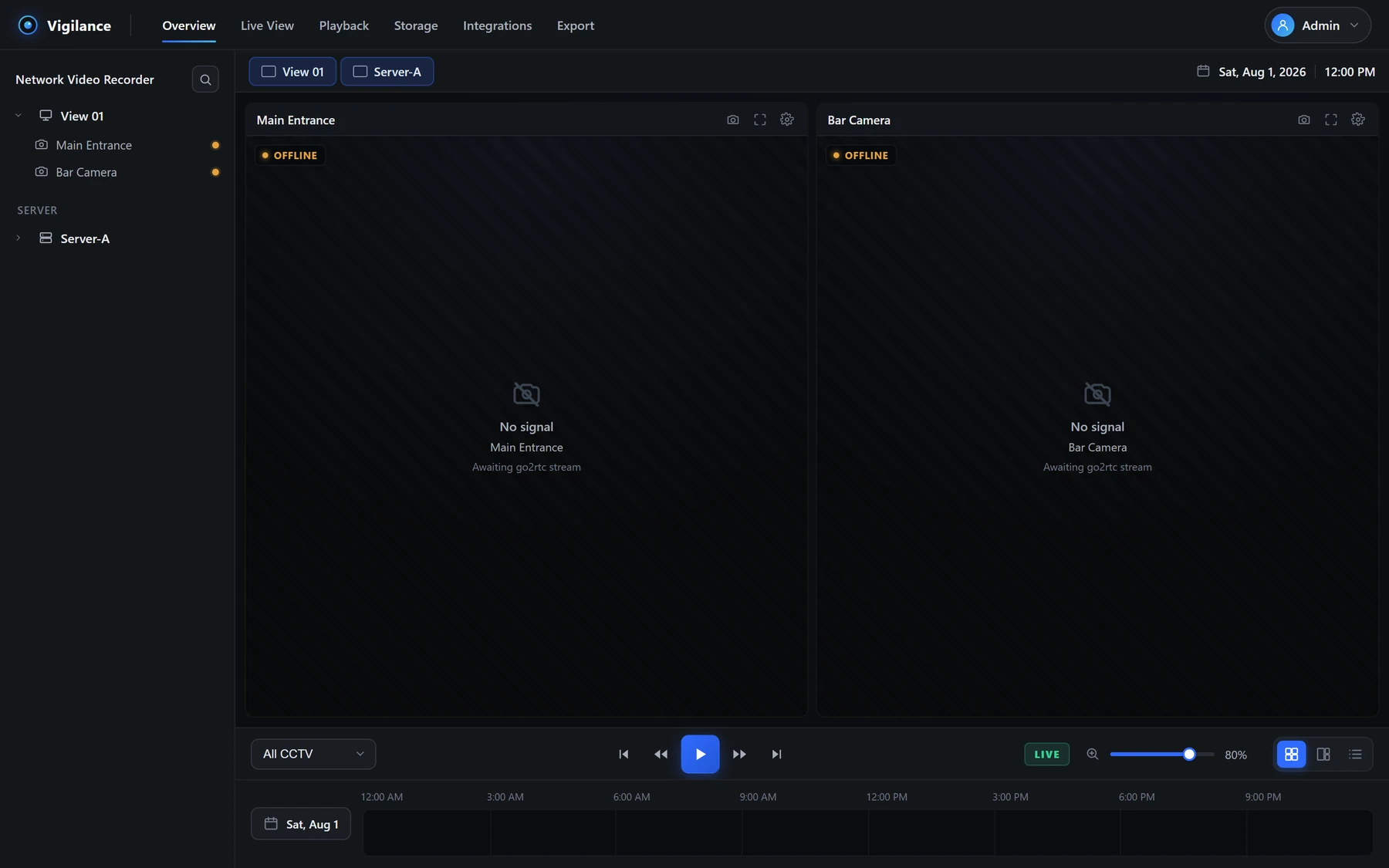
The prototype recorder shell with two zones configured — camera streams were not connected at capture.
Prototype on synthetic test data. Zone names are the synthetic run's own generic labels, not a real venue's camera configuration. No live footage has been connected.
A concrete example
Follow one exception from detection to a decision.
An illustrative example of a monitored zone, an exception, and the human review step that follows it.
- 1
Monitor
Zone observed
A defined, approved zone — a prep station, an entrance — is monitored continuously.
- 2
Detect
Activity counted
People, objects, or events in that zone are counted or logged against a defined rule.
- 3
Exception
Exception flagged
Activity outside the expected pattern is flagged — not silently acted on.
- 4
Review
A person reviews
The flagged event goes to a person with the authority to decide what happens next.
- 5
Record
Kept for compliance
The reviewed event and decision are kept as a record, within agreed retention limits.
When it fits
Vision is usually the right place to start when...
- Compliance or safety checks depend on someone remembering to look
- Loss or shrinkage is only noticed after a stock count, weeks later
- Queue, occupancy, or throughput issues go unseen until a customer complains
- You already have CCTV and want more than raw, unreviewed footage from it
Operating context
Vision is honestly the earliest-stage of Elion's proof — an active development effort, not a polished, shipped product.
AI Vision
Active developmentCCTV analysis, plate and object counting, people counting, and monitoring — genuinely in progress, not a finished, generally available product.
Status reflects each system’s stage today, not a commercial claim. Verified screenshots and full case studies are in preparation and arrive in a later stage.
Where this connects
A flagged compliance or loss-prevention event can feed straight into the operational record.
Flagged events route to the right person in Workspace for review — not into an unwatched folder.
On a busy floor, Vision can help confirm activity around a specific order or station.
The next step
Start with a Systems Assessment.
A focused conversation about how your operation runs today, where it loses time, and what a connected system would change. No obligation to build anything.
In an assessment we
- Understand how your operation runs today
- Identify the disconnected systems and bottlenecks
- Map the highest-value improvements
- Decide together whether Elion is the right fit